WordPix - Guess Word Picture
- 4.6
- Rating
- 1.00M
- Installs
- Free
- Price
 Analysis by App-foxy
I opened WordPix - Guess Word Picture expecting a familiar picture-and-word exercise, but its appeal became clearer after several rounds: the image gives me a starting point, my guesses create the tension, and the answer provides a small moment of release before I decide whether to continue. It is a free word game from HYPERCELL, available for Everyone, and it works best when I want something light that still asks me to pay attention.
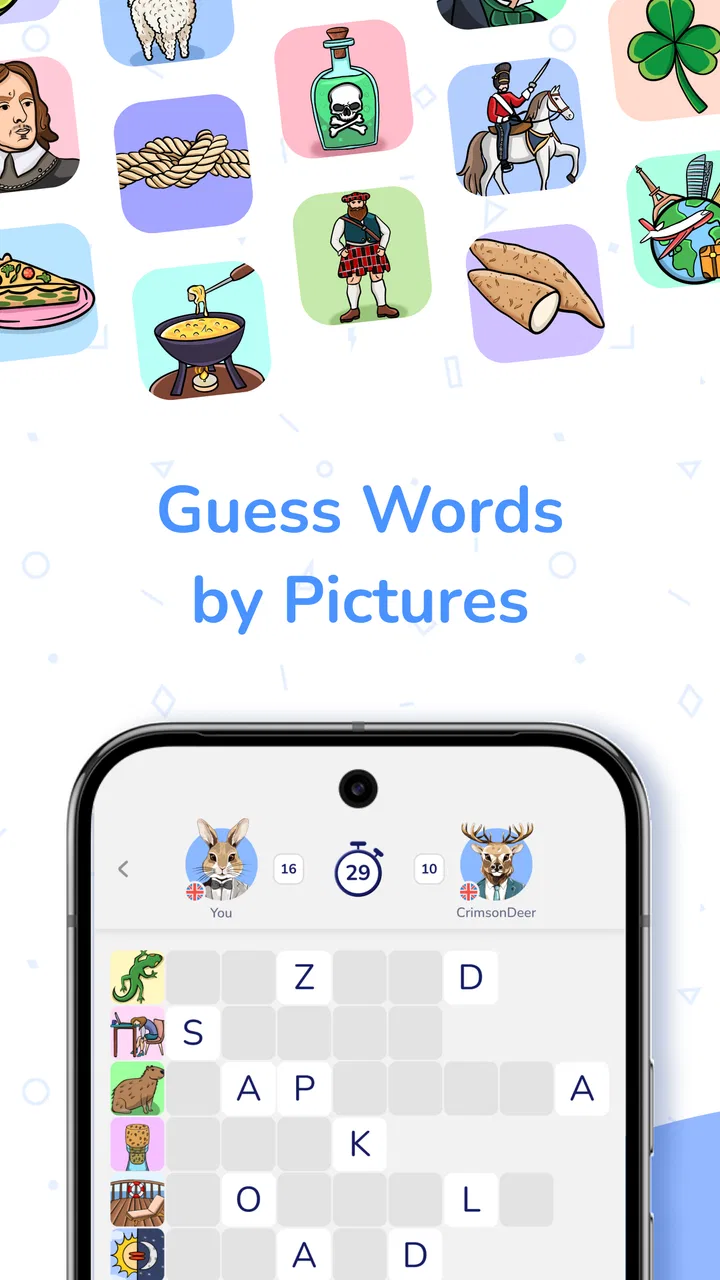
The basic idea is easy to understand. I look at pictures, search for the word connecting them, and submit my answer. That simplicity is important because I can begin without learning a complicated ruleset. At the same time, the game is not merely passive viewing. It asks me to notice relationships, test language, and accept that the most obvious interpretation is not always the intended one.
How the picture-to-word loop feels in practice
I focus here on what makes the picture-to-word loop satisfying, and where a clue can turn from a quick spark into a sticking point. In my experience, naming each image before searching for a shared idea helps keep guesses grounded rather than random. That small habit also makes it easier to decide whether I need a fresh look or simply a short pause.
You May Also Like

 Blood Strike: 2.5 Anniversary
Blood Strike’s Loadouts Turn Every Drop Into a Tactical Gamble
A close look at Blood Strike’s custom loadouts: how fast access to signature weapons reshapes its battle royale rhythm, rewards preparation, and narrows the gap between fights.

 Pandora - Music & Podcasts
Pandora’s Music Is Easy to Start, but Harder to Recover
Pandora’s strength is its low-effort path from a seed to a station. Its weak spot is how much confidence it asks you to place in connection, setup, and quiet recovery.

 8 Ball Pool
 Is Built on Rivalries, Rematches, and Routine
A close look at the rivalries, rematches, shared routines, and unanswered safety questions that turn a quick pool match into a persistent mobile community.

 Samsung Music
’s Quiet Strength Is Playing What You Already Own
Its reach comes less from spectacle than from dependable access to a personal library. That simplicity is both the app’s strongest retention engine and its ceiling.

 AccuWeather: Weather Radar
AccuWeather Review: A Quick, Clear Forecast for Everyday Decisions
For everyday plans, the best forecast is the one you can understand quickly. AccuWeather makes rain timing, radar, and local conditions easy to act on, with a few trade-offs.

 Hill Climb Racing
Why Hill Climb Racing Still Turns Crashes Into One More Run
A tiny car, a bumpy hill and one more upgrade: Hill Climb Racing keeps resurfacing because its simple chaos makes every near-miss feel personal.
More From Our News Desk



The first action is quick, but the observation matters
My first move is always to study the pictures before typing anything. That sounds obvious, yet it is where much of the game’s character appears. I try to name each image separately, then look for a shared idea rather than forcing the first word that comes to mind. This makes WordPix more interesting than a simple image-labeling exercise: the task is to connect clues, not just identify them.
I found it useful to say possible answers quietly or type them into a note when I was stuck. Doing that exposed whether I was thinking about the objects themselves, an action associated with them, or a broader word that could link the whole set. The game rewards flexible vocabulary more than fast tapping, so rushing can be less effective than taking a few seconds to inspect the visual details.
That first action also makes the game approachable for different ages. Younger players can focus on familiar objects and basic word associations, while adults may enjoy the ambiguity of clues that point toward an idea rather than a literal label. Because the content rating is Everyone, it is a reasonable choice for shared casual play, although the actual enjoyment still depends on how comfortable each player is with word puzzles.
Feedback keeps each attempt moving
Every guess has a clear emotional purpose. A correct answer closes the small question I have been carrying since the pictures appeared. A wrong attempt, by contrast, tells me that my interpretation needs adjusting. The important thing is that the game’s rhythm does not require a long explanation between attempts; I can look again, revise my thinking, and continue.
This feedback rhythm is why a short session can feel more involving than a standard scrolling break. I am not simply consuming one screen after another. I am making a prediction, checking it, and using the result to shape the next prediction. Even when a clue seems simple, that repeated cycle gives the game a modest sense of momentum.
One practical tip helped me avoid wasting time: when my first answer feels too specific, I step back and search for a more general connection. Picture puzzles often tempt me to focus on one striking detail, but the better answer may describe what the images have in common at a higher level. I also try not to overthink every clue immediately. If a straightforward association fits the full group, it deserves a chance before I invent an elaborate explanation.
The limitation is that this kind of feedback depends heavily on the quality of the clue. If the pictures do not suggest a connection that feels fair to me, the challenge can shift from satisfying deduction to trial and error. That is not a deal-breaker for a casual game, but it does mean serious puzzle fans may prefer a title with more explicit logic, layered hints, or a stronger explanation after an incorrect answer.
The reward is the answer, not a complicated system
WordPix gets much of its satisfaction from the moment a solution clicks. I enjoy the brief confirmation that my interpretation was right, especially after I had considered several possibilities. The reward is therefore mental as much as visual: I have recognized a pattern and turned separate images into one word.
This makes it a useful companion for small gaps in the day. I can play while waiting for an appointment, during a quiet coffee break, or when I want to switch away from a longer game without committing to a full match. It also works as a relaxed group activity. One person can describe what they see, another can suggest associations, and the discussion itself becomes part of the puzzle.
There is a subtle trade-off here. Players who want elaborate progression, competitive rankings, character upgrades, or a story may find the reward too modest. The pleasure comes from solving the individual challenge and choosing another one, not from building a complex account or mastering a large strategy system. I would recommend it to someone who enjoys wordplay for its own sake, but not to a player looking for a deep long-term game structure.
The free entry point makes trying it easy, while in-app purchases range from $0.99 to $20.99 per item. I would approach those purchases as optional convenience rather than part of the reason to install the game. For a casual player, the sensible approach is to begin with the free experience, decide whether the clue style suits you, and only then consider spending. The game’s core appeal should be clear before any purchase becomes relevant.
Resetting after a round is part of the appeal
After solving a puzzle, I rarely feel pressured to make the next round a major commitment. The mental slate is clean, and that reset is one of the strongest reasons another session begins. I can stop after a single answer or continue while the clues still feel fresh. This is a better fit for interrupted routines than games that punish me for leaving midway or demand a long uninterrupted run.
I used the reset in two different ways. When I was tired, I treated each puzzle as a tiny standalone activity and stopped as soon as concentration dropped. When I wanted a longer break, I let the solved answer create a natural bridge into the next challenge. That flexibility makes the game easy to place around real life rather than arranging my schedule around it.
It is also worth noticing what the reset does not provide. A short, repeatable loop can become predictable if I am seeking constant novelty or increasingly complex mechanics. The game’s strength is its low friction, and that same quality can make it feel lightweight after a long stretch. I would avoid treating it as a primary game for an entire evening unless I already knew that picture-word puzzles hold my attention for that long.
Who will get the most from this format?
I think WordPix is particularly suitable for people who enjoy visual clues but do not want a demanding crossword layout. It is also a friendly option for families, casual players, language learners who like connecting images with vocabulary, and anyone who wants a quick mental reset without reflex-based action. The pictures give players a shared starting point, which can make it easier to discuss than a puzzle built entirely from obscure written clues.
It is less suitable for someone who dislikes ambiguity. If you want every answer to follow a strict, mathematical chain, a traditional crossword, a word-search game, or a more deduction-heavy puzzle may feel fairer. Those alternatives usually provide a denser written structure or a more visible path toward the solution. WordPix instead asks me to interpret images and trust that a common connection exists.
It may also disappoint players who need a strong sense of mastery. A crossword can let me improve through clue conventions and grid strategy, while a picture association game may continue to surprise me with each new set of images. That unpredictability is enjoyable, but it can make progress feel less measurable. I become better at thinking flexibly, yet not necessarily better in a way the game clearly records for me.
Everyday use: a realistic short break
Imagine I have ten minutes before leaving for work. I do not want to start a story-driven game because I will have to stop almost immediately, and I do not feel like opening a competitive word app that might pull me into a longer routine. WordPix fits that moment well. I can inspect a puzzle, make a guess, enjoy the answer when I get it, and decide whether the next round deserves the remaining time.
Another useful situation is playing with a child or a friend who is not comfortable with complex game controls. I can hand over the device and let the other person lead the observation. If we disagree, we can explain why each picture suggests a different word. That conversation gives the game more life than solitary tapping, and it does not require either player to know a special strategy beforehand.
For language practice, I would use it as a supplement rather than a complete learning tool. The pictures can prompt vocabulary recall and association, but a player who needs pronunciation guidance, grammar exercises, or structured lessons should choose a dedicated language app instead. WordPix can make word recall playful; it should not be mistaken for a full course.
What the current app details mean for installation
The game was released on Apr 25, 2025, and the current version is 4.1.0. It requires Android 7.0 or later, so many older Android devices should be able to meet the operating-system requirement. I would still check the device’s available space and store compatibility before installing, especially on a phone that has not been updated for a long time.
Its reach is already substantial, with over 1 million installs and a 4.6 average from around 43 thousand ratings. Those figures suggest that the format has found a broad casual audience, but they do not replace my own test of whether the clue style feels satisfying. A popular word game can still be a poor match for someone who prefers strict clues, deep progression, or offline-focused play.
The developer is HYPERCELL, and the store lists the game as free. That combination makes the initial decision straightforward: install it, try several puzzles, and judge the loop before thinking about optional spending. I would pay attention to how often I feel curious about the next picture set rather than how quickly I complete the first few rounds. The real test is whether the reset creates genuine interest or merely repeats the same action.
How it compares with familiar word-game alternatives
Compared with a crossword, WordPix is more visual and less dependent on reading a grid of clues. I can begin with almost no setup, and the shared images make it easier for another person to join. The trade-off is that I get less control over the solving path. A crossword lets me jump between easy and difficult entries, use crossing letters, and build certainty gradually. Here, the pictures are the main evidence, so a single unclear association can hold me back.
Compared with a word-search game, it asks for more interpretation and less scanning. I am not hunting through a letter grid for a hidden sequence; I am forming a connection between images. That feels more conversational and imaginative, but it may be less relaxing for players who prefer a repetitive visual task with a clearly visible target.
Compared with daily guessing games, the picture format changes the source of difficulty. Instead of relying mostly on letter placement and vocabulary filtering, I have to translate visual information into language. That makes WordPix a better choice when I want variety in how I think, while a letter-based game may be better when I enjoy deduction from exact feedback.
My practical recommendation is to keep both types available for different moods. I reach for WordPix when I want a quick visual prompt and a clean restart. I would choose a crossword for a longer, more deliberate solving session, and a word search when I want something calmer and more mechanical. None of these formats replaces the others; they serve different kinds of attention.
Small strategies that make difficult clues less frustrating
My most reliable approach is a three-pass method. First, I name what each picture literally shows. Second, I list actions, qualities, or contexts connected with those things. Third, I look for the shortest word that can reasonably cover the set. This prevents me from locking onto the first image and ignoring the rest.
I also separate confidence from familiarity. Sometimes a picture looks familiar but points to a less obvious meaning, while another clue may be visually simple yet important for narrowing the answer. Treating every image as evidence, rather than decoration, helps me notice the relationship the puzzle is trying to create.
When playing with someone else, I ask them to explain their answer before revealing mine. That turns a wrong guess into useful information: I learn which visual detail led them in another direction. It is an especially good way to make the game engaging for children, because the conversation values observation even when the final word is not correct.
Finally, I stop briefly when frustration replaces curiosity. Since the game’s sessions reset easily, forcing an answer is rarely worth it. Returning after a few minutes can make the same pictures look different, and the low-commitment structure supports that pause. This is a small but meaningful advantage over puzzles that require me to maintain a complicated chain of deductions.
My verdict on the complete loop
WordPix succeeds because its loop is easy to describe but pleasant to repeat: I inspect pictures, propose a word, receive an immediate result, enjoy the satisfaction of a match, and then decide whether to begin again. The next session starts not because the game demands a large commitment, but because the last answer leaves me curious about the next visual connection.
The best reason to try it is the clean balance between instant access and genuine thought. It is more active than casual scrolling, less demanding than a serious crossword, and flexible enough for a short break or a shared guessing session. The picture-based approach also gives it a distinct personality among word games, particularly when I want to solve through association rather than letter patterns.
My reservations are equally clear. Ambiguous clues can feel less fair than structured alternatives, the lightweight reward may not satisfy progression-focused players, and extended sessions may expose the repetition in the central format. In-app purchase choices also mean I would keep my spending deliberate instead of assuming every optional item improves the experience.
For me, this is a game I would keep installed for brief mental breaks, family guessing, and moments when I want a word challenge without a large learning curve. If that sounds like your kind of play, WordPix - Guess Word Picture is worth trying as a free download. If you need deep strategy, rigorous clue logic, or a strong long-term progression system, I would choose a different word game instead.
FAQs for WordPix - Guess Word Picture
01What is WordPix - Guess Word Picture?
WordPix - Guess Word Picture is an engaging puzzle game where players guess words based on pictures. Each level presents an image, and players must deduce the correct word that corresponds to it. It's a fun and educational way to enhance vocabulary and sharpen problem-solving skills.
02Is WordPix suitable for all age groups?
Yes, WordPix is designed for players of all ages. Its intuitive interface and varying levels of difficulty make it accessible to children, teenagers, and adults alike. The game encourages family-friendly fun, making it an excellent choice for both solo play and group challenges.
03Does WordPix require an internet connection to play?
While WordPix can be enjoyed offline, some features, such as updates and certain in-game enhancements, may require an internet connection. Playing offline allows you to enjoy the core game mechanics without interruptions, making it perfect for on-the-go entertainment.
04Are there in-app purchases in WordPix?
Yes, WordPix offers in-app purchases. While the game is free to download and play, players have the option to purchase hints, remove ads, or unlock special features. These purchases are optional and can enhance your gameplay experience but are not necessary to complete the game.
05How can I get help if I’m stuck on a level in WordPix?
If you find yourself stuck on a level, WordPix provides hints that can be used to reveal letters or solve the word. You can earn these hints through gameplay or purchase them via in-app purchases. Additionally, the WordPix community offers forums and discussion groups for players seeking tips and strategies.
Pros
- Engaging gameplay for word puzzle enthusiasts.
- Simple interface enhances user experience.
- Regular updates keep content fresh.
- Offers offline play for travel or no-WiFi zones.
- Visual clues aid in learning new vocabulary.
Cons
- Limited hints may frustrate some players.
- Ads can be intrusive and disrupt flow.
- Some puzzles may be too challenging.
- In-app purchases can become costly.
- Requires storage space for app updates.

WordPix - Guess Word Picture
Gallery